Workforce turns frontier models into a coordinated workforce that ships real work — engineering, operations, analysis — inside the tools your team already runs on. Self-hosted, secured end to end, and getting smarter every day. Already in daily production with 60 users.
PLATFORM
Not a copilot. A coordinated team that ships.
Agents pick up work, do it, check each other, and ship — code, operations, analysis — with a human in the loop only where it matters.
HOW IT WORKS
Agents hand off tasks, share context, and work in parallel — a well-run team, not a single assistant waiting for prompts.
"Workforce gives a small team the output velocity of a team three to four times its size. It's a force multiplier."

CTO
Proptech PLATFORM

POWERED BY THE BEST AI MODELS. COMPETING WITH NONE OF THEM.
Claude writes code. So does Gemini. Workforce puts them to work.
Workforce routes every task to the right model and fails over automatically when a provider goes down — production-validated, 40–60% cheaper than running everything through the most expensive model. The model is the engine. Workforce is the driver.
UNDER THE HOOD
The architecture advantage
Four pillars that make Workforce production-grade
5 layers of memory active
memory since
Day 1 — Feb 2026
CAPABILITIES
Deep integrations, not shallow wrappers
Workforce connects to the tools your team already uses — managing the full lifecycle in each, not just reading data.
INTEGRATION
GitHub
Full PR lifecycle — clone, branch, review with inline comments, CI checks, and SHA-pinned merge. Agents manage the complete workflow autonomously.
INTEGRATION
Linear
Multi-workspace issue tracking with auto-triage, bulk operations, linked relations, and automatic prefix resolution across workspaces.
INTEGRATION
Slack
Agents live in your channels. Thread-aware replies, per-channel engagement controls, emoji reactions, file uploads, and multi-workspace support — they follow the social rules of a shared workspace.
INTELLIGENCE
Knowledge Graph
Indexes your entire codebase into entities and relationships. Semantic search, dependency traversal, impact analysis — all queryable in natural language.
INTEGRATION
PostHog
Product analytics, wired in. Agents query events, funnels and feature flags and surface what users actually do — with per-user OAuth or an org-wide token.
INTEGRATION
Metabase
Full dashboard control. Agents compose and edit dashboards — adding and removing cards and running questions — so reporting builds itself from data you already trust.
Plus anything else your team runs — connect any internal or third-party tool through self-hosted MCP, with proper OAuth and no bespoke wrapper required.
BY THE NUMBERS
Production-grade at scale
Workforce isn't a prototype — it's battle-tested infrastructure running across production codebases today.
7,600+
code entities indexed across production repos
26,000+
relationships mapped in the knowledge graph
40–60%
cost savings via adaptive model routing
IN PRODUCTION
In daily production. 60 users and counting.
We don't disclose names yet — but Workforce is in daily production right now, shipping real work on codebases teams depend on. Engineering is the beachhead, not the ceiling: the same engine — coordinated agents, knowledge surfacing, work that actually ships — runs operations and analysis across healthtech, family offices and financial services.
Want to be next?
We're onboarding a small number of teams each quarter. If you have real work that needs more throughput — engineering, operations, analysis — let's talk.

BUILT WITH RUST · SHIPS IN PRODUCTION
GET STARTED
Workforce integrates with your existing stack — no new UI to learn, no workflow to change.
STEP 1
Configure
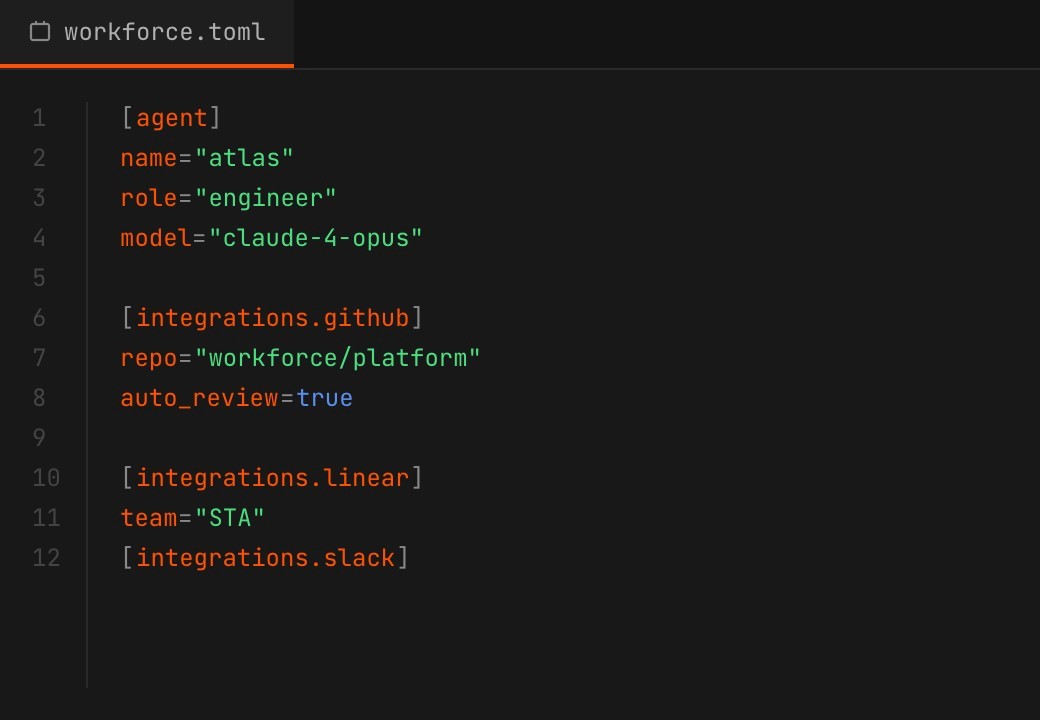
Define agents in a single TOML file. Give them identity, capabilities, memory, and tool access. Connect to GitHub, Linear, and Slack.
STEP 2
Deploy
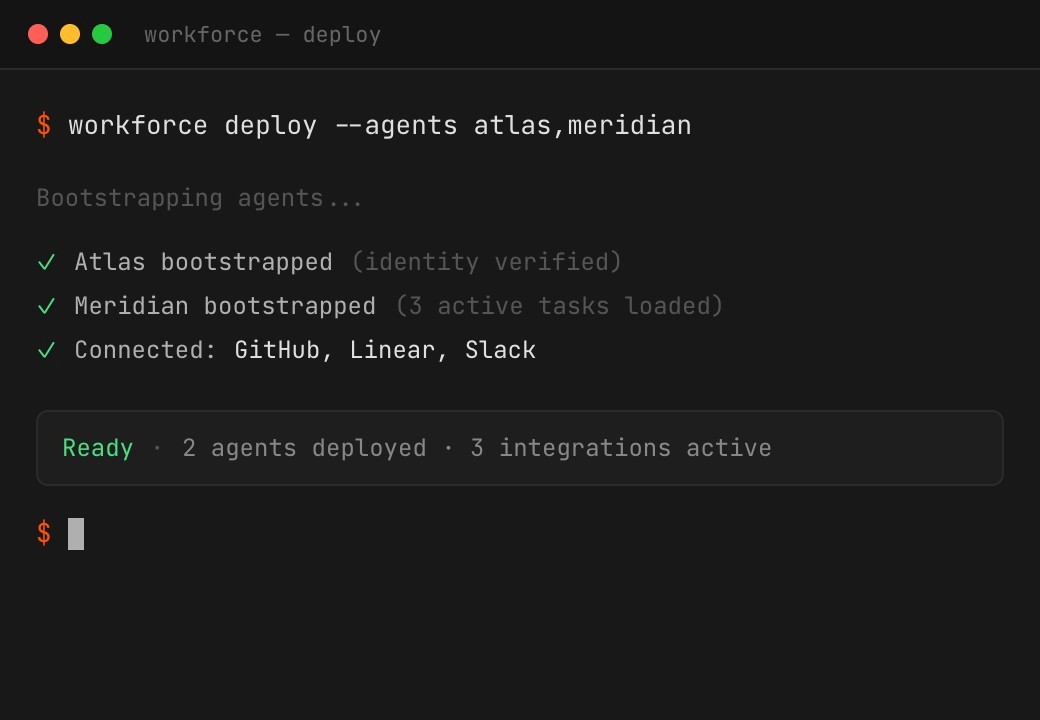
Agents bootstrap themselves — reading identity files, checking recent work, scanning for active tasks. If there's unfinished work, they resume. If clear, they wait for instructions.
STEP 3
Scale
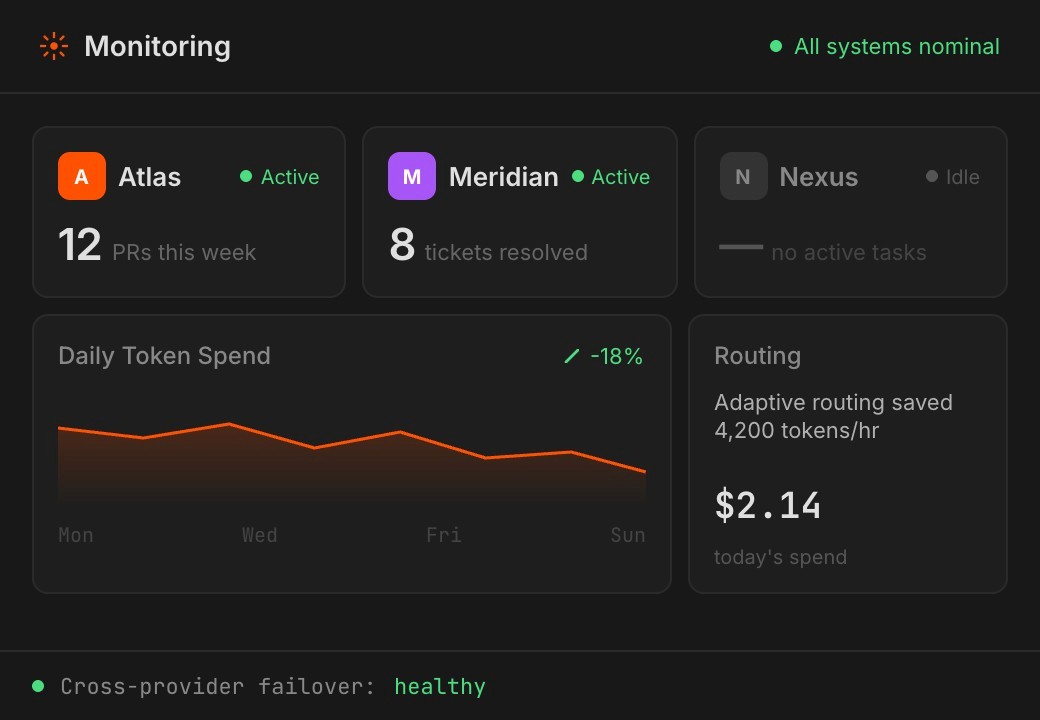
Add agents as workload grows. Spin up sub-agents for parallel execution. Adaptive routing optimises cost automatically. Track per-ticket costs in real time.
INSIGHTS
Thinking on AI engineering
Perspectives on autonomous agents, orchestration, and the future of software development.


EARLY ADOPTERS
What engineering leaders are saying
Early adopters on what it's like to have AI agents shipping alongside their team.

FAQ
How is Workforce different from GitHub Copilot or Cursor?
Copilots autocomplete your code line by line. Workforce agents autonomously pick up work, understand your codebase and context through a knowledge graph, do the work end to end — code, operations, analysis — review each other, and ship when checks pass. They're teammates, not autocomplete.
Is Workforce self-hosted?
Yes. Workforce runs entirely in your infrastructure. Your code, your data, your control. This is critical for organisations handling sensitive data or operating in regulated industries.
What LLM providers does it support?
Workforce supports Claude, Grok, and Gemini with automatic cross-provider failover. If your primary provider goes down, agents seamlessly switch to the next available model. Adaptive routing also optimises cost by matching task complexity to model capability.
How long does deployment take?
Most teams are running their first agents within days. Agents are configured in a single TOML file, connect to your existing GitHub, Linear, and Slack, and bootstrap themselves automatically.
What programming languages does it support?
Workforce is built in Rust and is language-agnostic — agents can work with any codebase. The knowledge graph indexes functions, structs, traits, and modules across your entire repo.
How does the memory system work?
Workforce uses five layers of persistent memory — working, episodic, semantic, team, and organisation — backed by both filesystem and vector store. Agents actively curate their long-term memory during scheduled heartbeats, reviewing daily notes and distilling what matters.
What does licensing look like?
We offer flexible licensing models including annual platform licenses with implementation support. Book a demo and we'll walk you through pricing based on your team size and needs.